
#206: Undertow
The surface reading of this World Cup, this M&A wave, this jobs data, is rarely the real one. This issue is about the currents running underneath: search spikes that won't convert, hosting that doesn't move demand, an AI jobs panic the data doesn't support, and reputations that don't hold up once you show up and see for yourself.
Special thanks to Signifyd for sponsoring this edition of the newsletter:

Travel's next margin problem isn't fraud. It's customers who know exactly how your policies work. Refund farming, serial cancellations, and flexible booking abuse are quietly eating into revenue. Individually, they're small. At scale, they're expensive. And most fraud tools weren't built to catch them. Here's why that needs to change: When customer-friendly policies become commercial risk
When being harder to find becomes the strategy
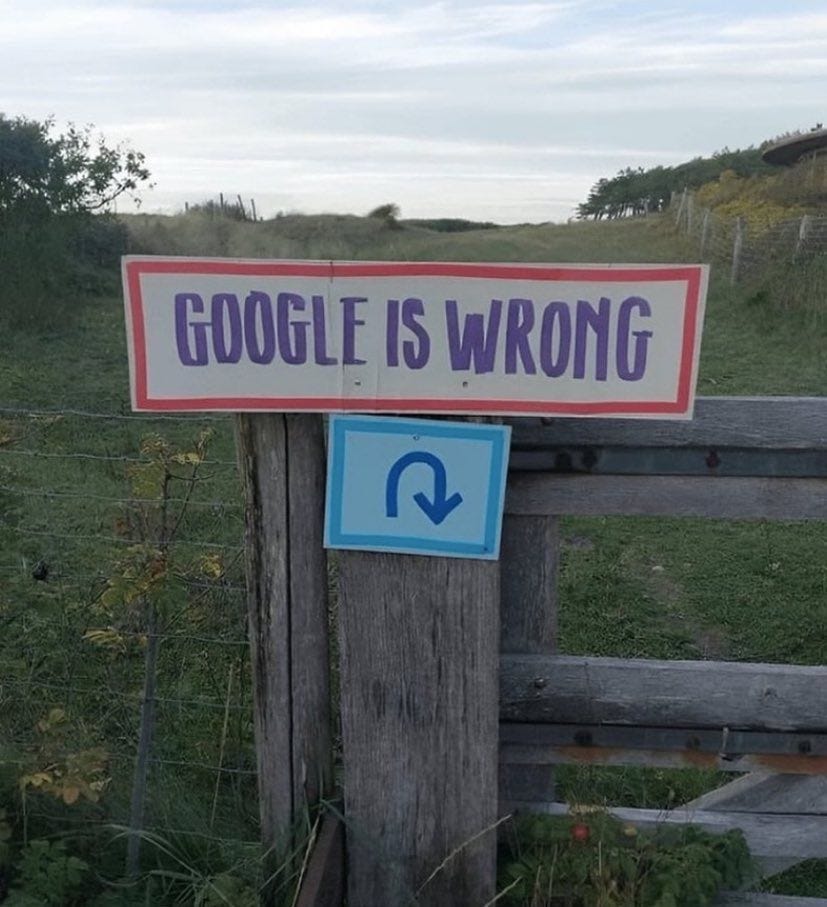
JoseLuis Vilar spotted a handwritten “Google is wrong” sign nailed to a fence, pointing traffic back the way it came.
The internet spent 25 years assuming that more visibility always wins. Better maps, better search, better prices. Vilar’s question is what happens once everyone chases the same signal so hard that the signal stops working.
Barcelona ran into this in 2024. Google and Apple pulled bus line 116 from their maps after tourists using it as the fast route to Park Güell crowded out the locals the route was built for. The city had the route pulled from the map and made a worse map on purpose.
Travel is facing a version of the same problem. Airline sites were designed for people, not for AI agents that crawl every route without tiring. Amadeus has started precomputing fares specifically to feed those agents, so they stop hammering live systems directly.
What looks like a broken interface may increasingly be a decision about which fares and routes stay open to machines, and which value gets reserved for customers who are still worth designing for directly.
The next M&A wave is aimed at stale internet companies
Stripe, Block, and the PE firm Advent are offering $53 billion for PayPal. On the All-In podcast, the hosts framed it as something bigger than one deal. It may be the start of a pattern where AI-native operators buy up mature internet-era businesses that founders left long ago and haven’t been run well since.
PayPal fits the profile. Chamath Palihapitiya referred to it as a 25-year-old product, still growing, but grown stale under a series of professional managers after eBay pushed out the founding team in 2002. Ryan Cohen (the investor behind the Chewy and GameStop turnarounds) has built a stake in eBay, and the hosts cited it as the same pattern. So did Bending Spoons, the Milan-based company that’s bought AOL, Vimeo, WeTransfer, Eventbrite, and Evernote, then diagnosed each one for overspending and under-using AI before rebuilding it leaner.
The travel industry has no shortage of similar candidates. Several major booking platforms and legacy travel brands are decades old, publicly traded or privately owned, no longer run by their founders, and slow to rebuild around AI. If this thesis holds, travel won’t be exempt from it.
The infrastructure layer
Seven years bootstrapped, profitable, and no press releases. Then a $48 million Series A led by Accel, with Booking Holdings’ Chairman and Priceline’s former CEO among the investors. Nuitée is trying to become travel’s Stripe; one API instead of months of supplier negotiations, and it seems to be working. The company now processes more than 2 billion hotel searches a day across 2.9 million properties, powering embedded travel experiences for companies like Revolut and Grab that weren’t travel companies to begin with.
I wrote a deep dive on how they got here, why AI could reshape travel distribution, and what that means for hotels, OTAs, and the infrastructure layer underneath it all: Nuitée: The Invisible Infrastructure Behind the Next Era of Travel
Curious how I choose companies for these sponsored deep dives? You can read about my process here. If you think your company might be a good fit, I’d love to hear from you.
AI may change airline org charts
This piece from Houman Goudarzi (founder/CEO of Vorsee) explores what an AI-native airline might look like. Instead of viewing AI as another tool for revenue management, pricing, or marketing, he asks what happens when AI coordinates every commercial decision across the airline.
Today, revenue management, network planning, marketing, sales, distribution, and retail all optimize their own part of the business. AI agents make it possible to coordinate those functions around shared commercial objectives. In Houman’s vision, specialized agents continuously collaborate on demand forecasting, network planning, offers, distribution, and commercial strategy instead of operating in isolation.
The exact number of agents matters less than the underlying idea. AI gives airlines the opportunity to rethink organizational structures that were designed decades ago. That question extends well beyond aviation. Many companies will have to decide whether their existing org charts still make sense once AI can do the coordinating.
The World Cup was also a brand audit
The 2026 World Cup also tested how the three host countries measured up against their own reputations.
Mexico delivered what everyone expected. Loud, colorful, festive, friendly and generous fans with an atmosphere that matched the hype. Nothing here changed anyone’s mind. It simply confirmed what people already believed.
The United States did the opposite. British fan Oliver Henry arrived in Dallas expecting to confirm every stereotype about the country and instead posted that Brits "owe America an apology." The BBC tracked the wider trend of fans posting the same disbelief, from Costco runs to a small Kansas town that learned Algeria's national anthem and greeted the team's fans in Arabic.

Canada landed somewhere in between. Visitors largely got the Canada they expected. Polite, organized, welcoming, and set against beautiful scenery. It didn’t surprise many people. It reinforced an existing reputation and did it well.
Reputation and reality don’t always match. This tournament happened to put three national brands side by side.
The World Cup search spike that never became bookings
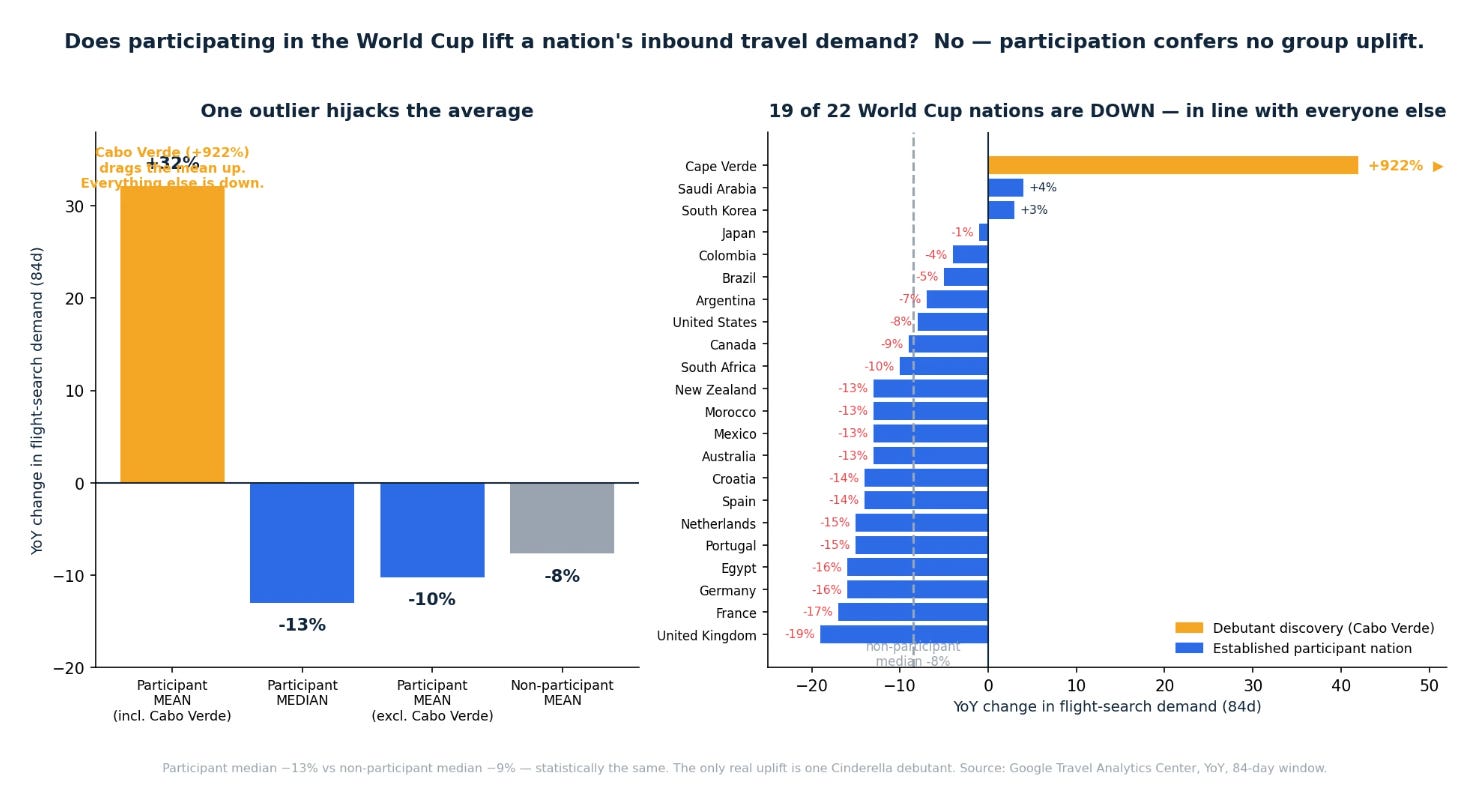
Cabo Verde was one of the World Cup’s sensations, and flight searches for the islands spiked 424 times over baseline. Digital Sardine tracked Google flight-search demand by origin country from April through early July and compared it against a pre-qualification baseline, and found that almost none of it will convert.
The US alone drove two-thirds of the surge. Add Canada and Mexico, the three host nations, and that’s 74% of total demand, none of it from countries with any real air access to Cabo Verde or a history of sending tourists there. Meanwhile, the UK, France, and Belgium, the markets that book Cabo Verde trips, were flat or down year over year. The spike was a TV audience Googling a place it fell in love with, not booking intent.
Hosting the tournament barely moved anything either. Host regions saw demand rise 7.5% during the tournament; non-host regions rose 7.4%. Mexico City fell despite hosting the opener. Miami dropped while hosting matches.
Even winning did nothing. Spain lifted the trophy and its inbound travel demand was still down 14% year over year. Across participating nations, 19 of 22 finished the tournament with demand down, statistically identical to countries that weren’t in it at all.
The one real mover was novelty. Cabo Verde, a country nobody expected to see at a World Cup, created a genuine demand spike. Spain, a country everyone already knows, didn’t, even by winning the whole thing.
Travel barely shows up in the US unicorn list
Stanford’s Ilya Strebulaev tracks every US company worth $1 billion or more while still private. The dataset has 938 of them. Search “travel” and you get 12. If you look closer, the number shrinks further. Waymo, Mapbox, Axiom Space, and Prometheus Fuels are mobility, mapping, and fuel companies, not travel companies. Nomad Health staffs travel nurses, more healthcare than travel. Away's parent JRSK makes luggage, a travel product, not a travel company.
What’s left: Breeze Airways, Hotel Engine (no-contract hotel booking marketplace designed to manage corporate travel and business trips), Outdoorsy (road trips and RV adventures) and Spotnana (corporate travel infrastructure).
Four travel companies out of 938 unicorns, in one of the largest industries on the planet.
Travel agents already ran this experiment
Before there was AI job panic, there was travel agent job panic. The data on how that played out is worth remembering right now.
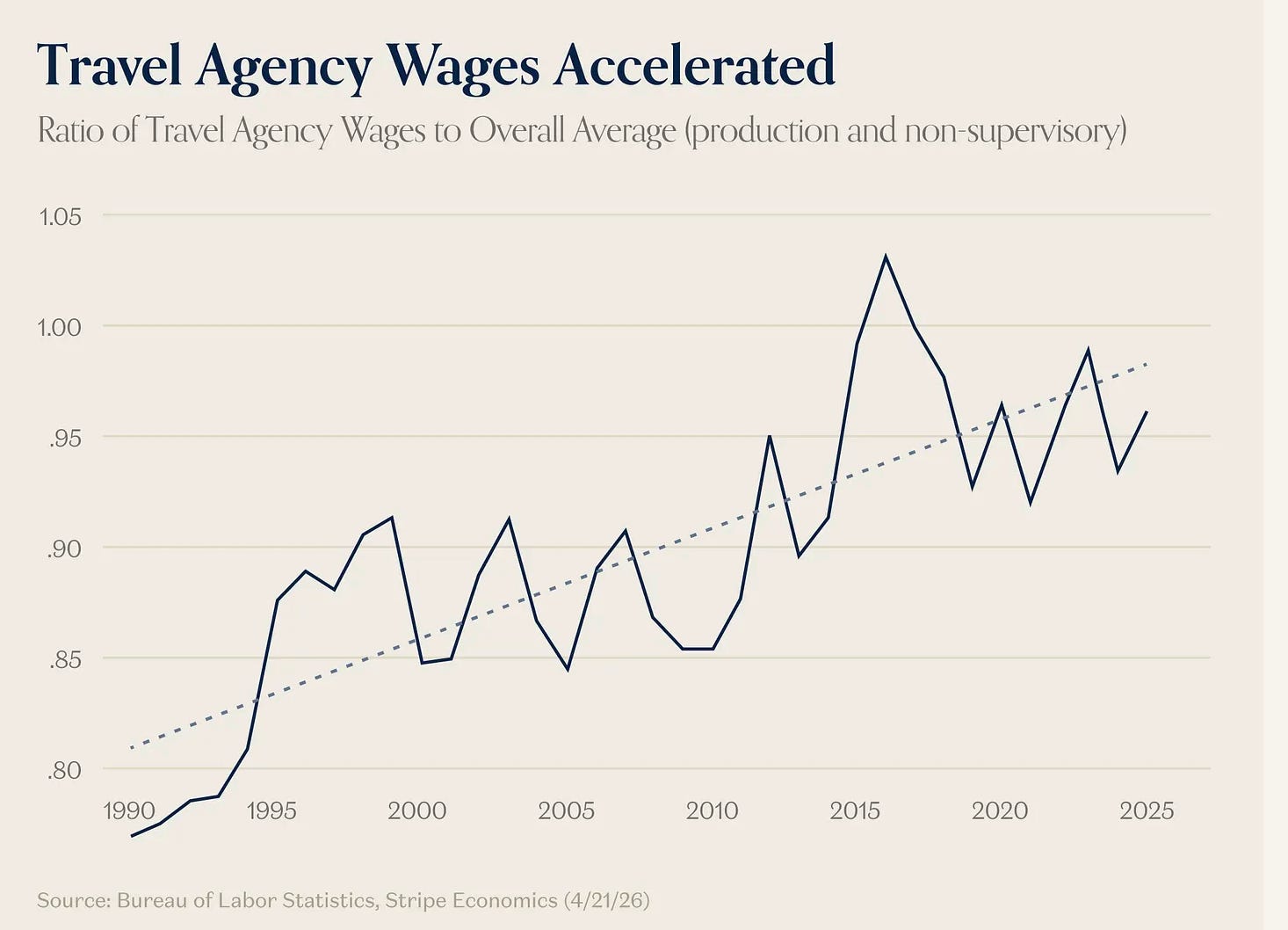
David George at a16z built a case against predictions of mass AI unemployment, and travel is a clean example. Stripe economist Ernie Tedeschi’s data shows travel agency payroll is about half what it was in 2000, mostly due to online booking tools. That part matches the doomer story.
The rest doesn’t. Travel agents didn’t disappear into unemployment. They moved into other parts of the economy, which today employs roughly the same share of working-age people as it did in 2000. And the agents who stayed got paid better for it. Average weekly earnings at travel agencies were 87% of the overall private sector average in 2000. By 2025, that ratio hit 99%.
Most jobs that exist today didn't exist in 1940. In 2000, it was easy to picture the travel agents who'd lose their jobs. Nobody could have pictured the tech services industry that would eventually form around cloud migration.
Fewer travel agents, doing higher-value work, paid closer to the market average than ever. Not the story people tell about automation, but the one the data shows.
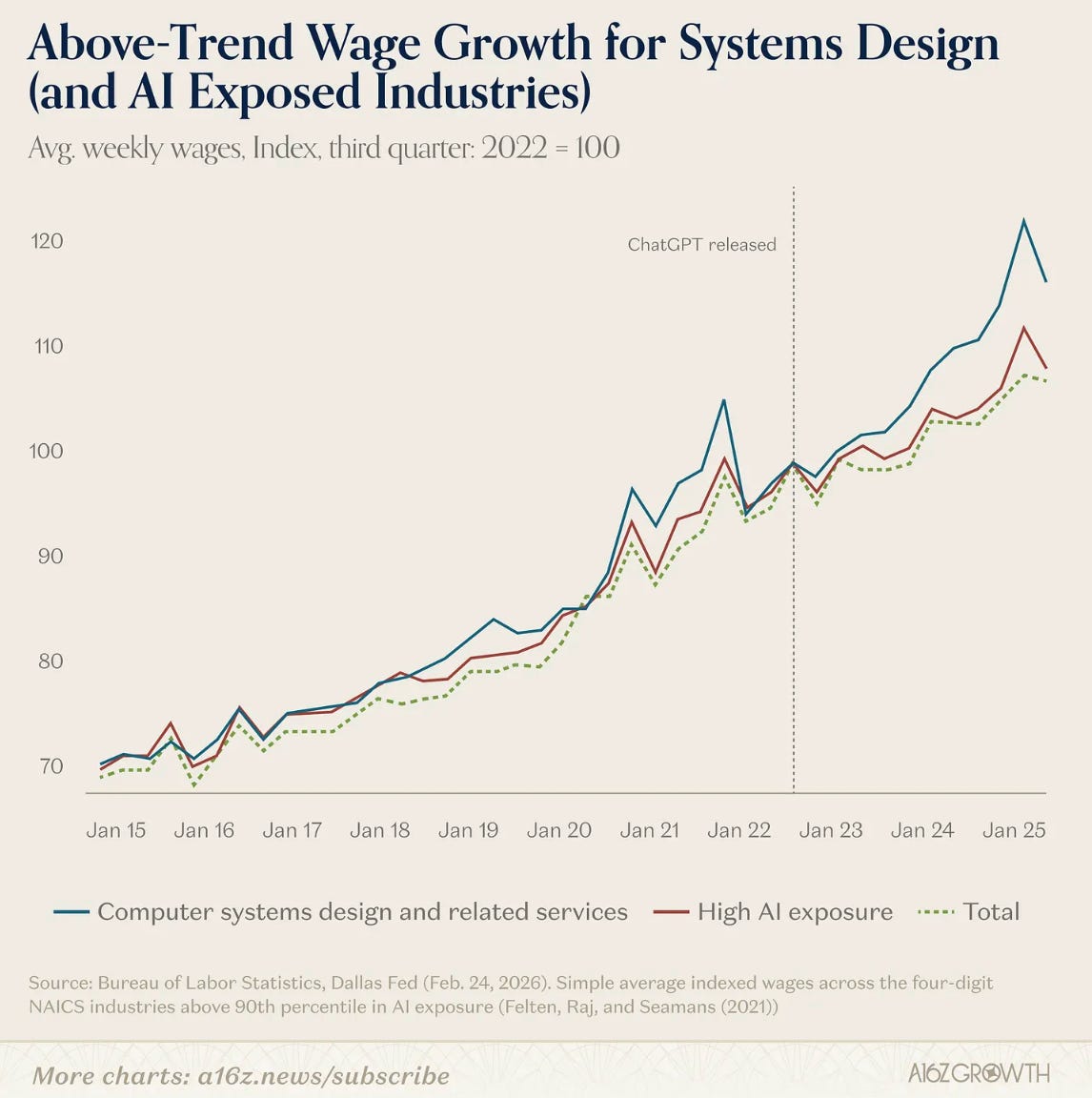
George backs it with recent numbers across the wider economy. A Federal Reserve Bank of Atlanta survey found more than 90% of firms report no employment impact from AI over the past three years. A Census Bureau study of AI-using firms found only about 5% reported any headcount change at all, split almost evenly between hiring more and hiring less. Where an effect does show up, it's a shift toward roles AI augments rather than replaces: software job postings are trending back toward pre-pandemic levels, and wages in high-AI-exposure industries have pulled ahead of the overall index since ChatGPT's release.
Raising a round?
If you are a startup looking to raise a round (from pre-seed to Series D), I can help (for free). Travel Investor Network is a private platform where I recommend innovative travel startups to investors and innovators. If you’re interested, please start by completing this form.
Travel Tech Essentialist Job Board
→ Explore all 1468 open roles on the Travel Tech Essentialist Job Board now.
Valpas | Head of Success | Helsinki or London (Hybrid possible)
The Hotels Network | Senior Revenue Manager | Ft Worth TX; Dallas
📩 For monthly updates on the latest roles, subscribe to the Travel Tech Jobs newsletter
If you’ve found value in Travel Tech Essentialist, the best way to say so is to share it with someone who’d appreciate it:
If you’re not yet subscribed, join us here:
Thanks for trusting me with your inbox.
Mauricio Prieto
Most AI job-loss commentary stops at the payroll drop and never asks what happened to the people. The specialization data buried here is the answer. It does not fit the panic story, which is why nobody keeps writing about it.