
#207: Evidence
Narratives meet numbers
What OTA stocks are doing in the AI era, the case against AI job doom, job board conversion rates, the real cost of agentic search, and a prediction I made 20 months ago that just came true.
Special thanks to Propellic for sponsoring this edition of the newsletter:

Love travel as much as we do? NavLog, the bi-weekly travel marketing digest by Propellic, is where industry-defining marketers go to stay on top of their game. Recent issues unpack ChatGPT ads for Travel and whether you’re optimizing for the AI travelers actually use. Join 2,000+ travel marketers
1. Reports of the OTAs’ death have been greatly exaggerated
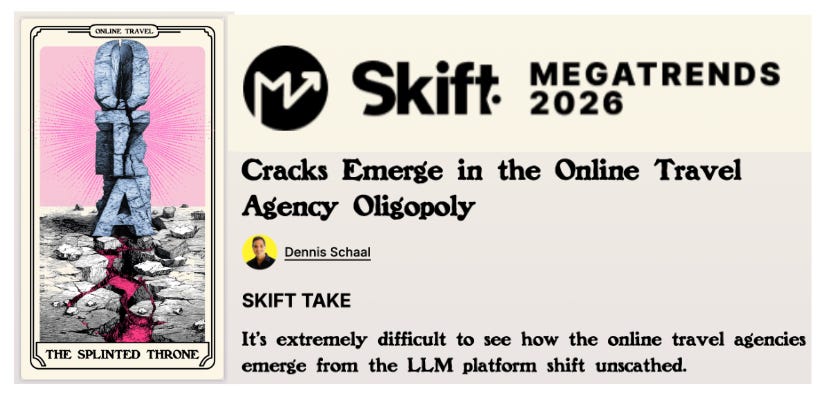
One of Skift’s 2026 Megatrends predicted cracks forming in the OTA oligopoly, warning that it’s “extremely difficult to see that the OTAs would emerge from the LLM platform shift unscathed.” AI agents could come between travelers and Booking, Expedia, and Airbnb, reducing them to invisible fulfillment layers. It’s a reasonable case to make, and also a little apocalyptic; the kind of confident narrative that’s easy to write into the obligatory year-end Megatrends predictions.
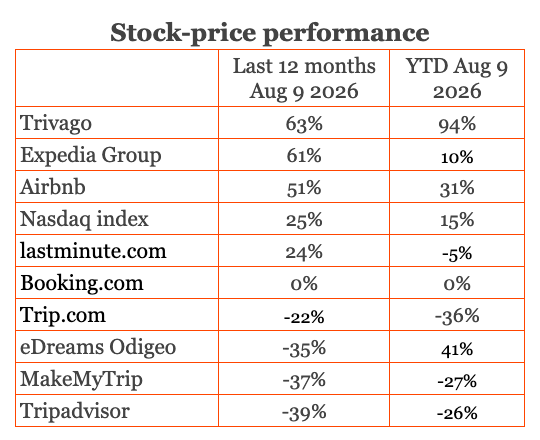
Seven months later, the numbers aren’t cooperating. Expedia traded at a new all-time high of $327 on August 5, the day of its Q2 report, after revenue rose 14%, gross bookings grew 12%, and the company raised full-year guidance. It closed at $311 on August 7, up 61% over the past 12 months. Booking Holdings has gained back most of what it lost earlier this year to that same disintermediation narrative. On August 7, Airbnb had its biggest single-day stock rally ever after boosting its annual revenue forecast for a second time this year. Its shares closed at $178, up 17% for the day and 51% over the past year.
None of this proves AI is irrelevant to travel distribution. It suggests that AI may commoditize discovery, but the companies that hold supply, payments, service, trust, and the ability to complete a booking are not automatically disintermediated. They may become more valuable infrastructure.
Seven months is not seven years. The megatrend could still end up being right. But for now, the companies it warned about are putting up some of their strongest numbers yet.
2. It depends
The global platforms have so far held up far better than the rest of the public travel-market set. Expedia and Airbnb have both materially outperformed the Nasdaq over the past 12 months, while Booking is flat. That is not universal outperformance, but it is a long way from an AI-driven unraveling of the incumbents.
Outside the so-called oligopoly, the picture changes. Trip.com, eDreams ODIGEO, MakeMyTrip, and Tripadvisor are all down over the past 12 months. Trivago, a metasearch business, is the outlier and the group’s strongest performer.
The YTD view makes the split even messier. Trivago and Airbnb are up sharply, eDreams has recovered strongly, and Trip.com, MakeMyTrip, and Tripadvisor remain down.
“OTA” is too broad a category for the AI-disintermediation story. Different travel platforms have different economics, geographies, and exposure to the agentic future.
3. One down, twenty to go
In December 2024, I published “21 ridiculously specific predictions for 2025”. I'll grade the full set at the end of this year, but I'll go ahead and grade Prediction 18 early. It said that a travel advisor marketplace would hit $1 billion in bookings with over 10,000 independent advisors, proving the creator economy model works in luxury travel. Last month, Fora closed a $60 million Series D at a $1 billion valuation. The company reached its first billion in bookings in three years, its second in eight months, its third in five, and it has more than 15,000 active advisors, 97% of whom are new to the profession.
Prediction 17, the fully autonomous, zero-staff hotel that beats the Four Seasons on guest satisfaction, hasn't happened yet. Give it time.
4. The search that never stops
According to an OAG post, a developer recently pointed an AI agent at Etihad’s website and asked it to find one flight. The agent returned 881,076 fare options, quietly crawling every date, stopover, and route combination a human never would.
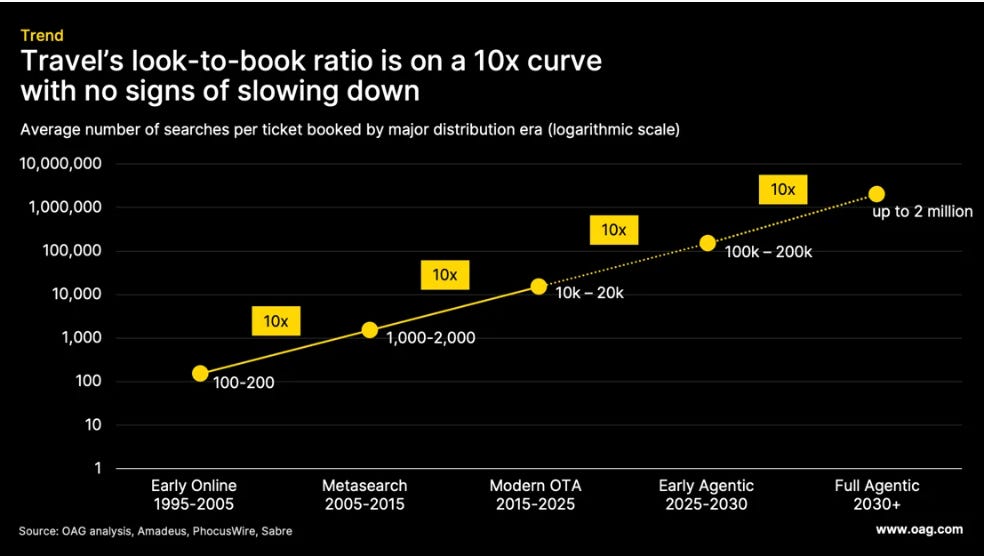
That’s the economics problem agentic travel is running into. A human search has a natural brake: people get tired, bored, or satisfied with “good enough.” Agents don’t. OAG estimates the industry has gone from roughly 100 to 200 searches per ticket sold in the early online era, to somewhere around 10,000 to 20,000 today. Amadeus and Sabre have both pointed to a possible future of up to 200,000 searches per ticket sold once agents are doing the shopping.
Someone pays for all that compute. Amadeus’s answer, according to its president of travel Decius Valmorbida, is to stop calculating a fresh price for every single query. Instead, for common routes and dates, Amadeus precomputes likely fares in advance and serves those saved answers instantly, refreshing them periodically rather than recalculating from scratch every time an agent asks.
If agents end up doing much of the shopping, the fare itself is not the only thing that matters. The infrastructure that decides which fares an agent sees, how quickly it sees them, and whether the offer can still be honored matters too. That gives whoever runs the cache, refresh logic, and revalidation layer real influence over the market. An airline whose offers are less current or less reliably bookable risks being repriced at checkout, or becoming a worse option for the agent to recommend.
5. What the market is telling you
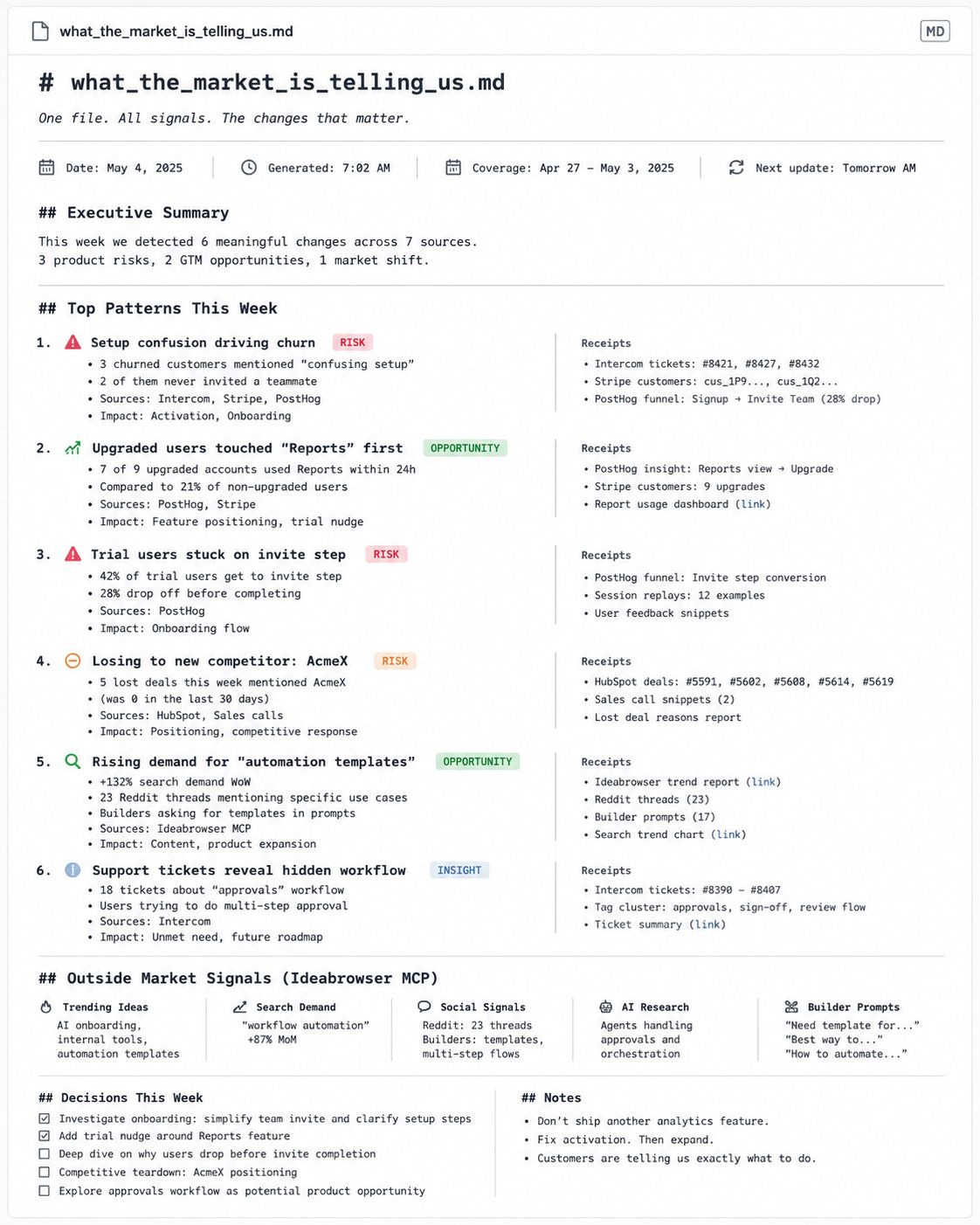
Greg Isenberg suggests that every startup should have a daily file, something like what_the_market_is_telling_us.md, that an AI agent updates each morning by pulling from every place customer truth lives. Stripe for who’s paying, upgrading, or churning. Product analytics for what people actually do. Support tickets for what they complain about. Sales call transcripts for what they say out loud. Most dashboards summarize what happened. This one comes with the evidence behind each pattern and the decision it points to, precise enough to act on the same morning.
That distinction is important. Maybe the customers who churned this week all mentioned the same setup confusion. Sales calls that used to close against a familiar competitor might suddenly be losing to a new one. And the customers who upgraded fastest may have all touched the same feature right before they paid. Most founders never catch that kind of thing until it shows up in a quarterly number, by which point it's been true for months.
Most companies already have the data to see this. They just don't have anything looking at it every morning.
6. Acai Travel (and others) get more applications per job posting than the big players
Travel Tech Essentialist Job Board data for the past 365 days shows that the companies posting the fewest roles are the ones getting the most applications per posting, not the biggest, most recognizable companies posting a large volume of roles.
For instance, Acai Travel gets roughly 16 times the average number of applications per posting, on just 15 postings over the past 365 days. Fora posted 135 roles over the past 365 days, well above the board median, and still gets over 7 times as many applications per posting as the average listing. Protect Group is close to 5 times, on 55 postings. BizAway is at 1.75 times, on 296.
Booking.com posted 1,153 roles over the past 365 days and had a below-average number of applications per posting. Airbnb is the exception: over 2,400 postings over the past 365 days and still above average in applications per posting.
7. The importance of job titles (and location)
More Travel Tech Essentialist Job Board data. Vague job titles cost companies job applications. Using the average listing as 1.0x, postings with no seniority level in the title, generic “Associate” or “Specialist” roles instead of something like “Associate Manager,” get just 0.57 applications for every one an average listing gets.
Titles that name the level do better. Manager titles get 1.5x the applications of an average posting. Director and Head of roles get 2.7x. C-level titles get 9x. VP titles get 13x, the highest of any level.
Location has an even bigger effect. Remote postings get more than 5x the applications of an average listing, the strongest single factor in the data. The US, a quarter of everything posted on the board, gets 1.3x the average applications per posting. Germany (2x) and Spain (1.6x) do even better.
Two takeaways for companies posting a job on our board or anywhere: say what the role actually is, and if it can be remote, say that too.
8. The solo founder problem is disappearing
Solo founders used to hit a ceiling fast. One person can’t be a marketer, a developer, and a salesperson at once, so growth meant hiring. That math is changing.
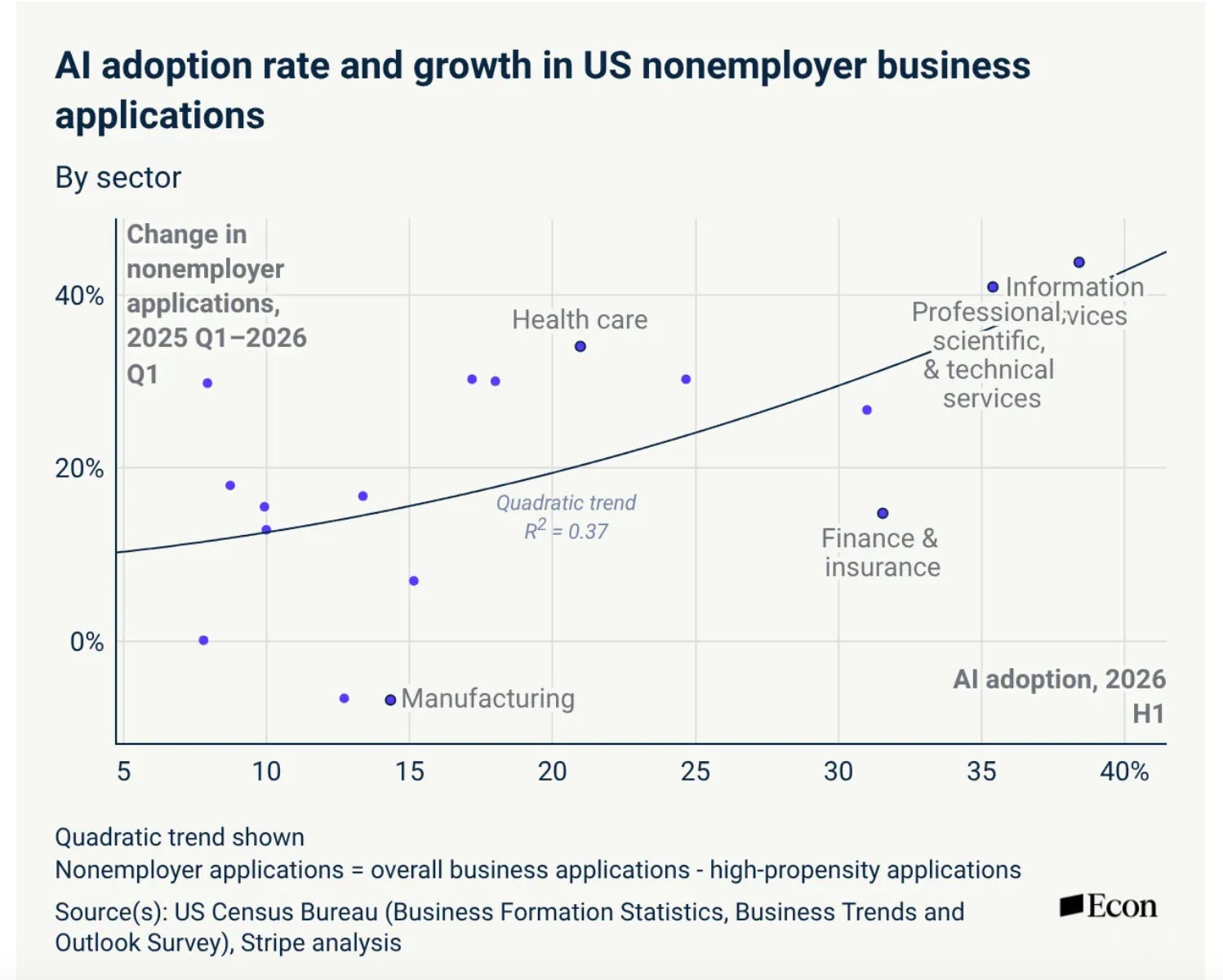
Stripe’s economics team published data on US solopreneurs showing that those earning over $1 million a year more than doubled between 2023 and 2025. The ones earning $5 million and $10 million nearly tripled. Delaware incorporations, often favored by startups planning to raise institutional capital, are up roughly 40% year over year since early 2025, a sign this isn’t just side-hustle noise. The underlying pattern isn’t US-only: business registrations have grown sharply in France, Finland, and Australia over the same stretch too, and in France specifically, the growth is coming from solo founders rather than companies that hire.
The reason is that AI is closing the skill gaps that used to force a founder to hire. Marketing, pricing, basic dev work, deal support, the stuff that used to require a second or third person now gets handled by tools. Sam Altman called it the “revenge of the idea guys.”
Stripe’s sector data shows the sectors adopting AI fastest are also the ones seeing the most solo business growth. Information and professional services are highest on both counts.
9. The moat you have to earn
DoorDash just became the eighth drone operator in the US to earn FAA Part 135 air-carrier certification, the regulatory framework used for commercial operations including charter flights and drone package delivery. Getting it means clearing the FAA’s five-stage certification process, including inventory syncing, handoff systems for rooftops and drive-throughs, and the operational layer that makes deliveries land on time. Read +
Only eight US companies hold this certification for drone delivery. That scarcity, not the drone hardware, is the real asset.
Travel has a version of this too. A travel agency without IATA accreditation usually has to ticket through an accredited consolidator or host and give up economics on every booking. An agency that earns its own accreditation keeps more of that margin and controls its own ticketing and settlement with airlines instead of depending on a consolidator who can change the terms.
Worth asking about your own product: which piece of infrastructure are you renting that, if you owned it, nobody could easily take from you?
10. A 19th-century coal argument explains the AI jobs debate
In 1865, the economist William Stanley Jevons noticed something strange about the steam engine; making coal use more efficient made Britain burn more of it, not less. Cheaper power created demand nobody had planned for.
That idea, now called Jevons paradox, keeps resurfacing in AI conversations, and Nvidia is the current example. The assumption was that better training techniques would mean labs need fewer GPUs. Jensen Huang’s answer, discussed on a recent episode of My First Million, was that training gets more efficient, but inference demand goes up a million times over. The pattern shows up whenever a core input gets cheap enough. Gutenberg’s printing press led to more books, and it also created reading habits and entirely new forms of writing that didn’t have a name yet. Cheaper code from AI may do the same thing to software, not by eliminating the need for developers, but by expanding what gets built into places code was never economical before.
The hosts also made a point about young people entering the workforce right now. Past technology shifts always drew resistance; bank tellers protested ATMs, workers smashed weaving machines during the Industrial Revolution, and every time, the “resistance” lost while the technology and the workforce both came out ahead. Young people have the least tied to the old way of doing things and the most time to build with the new one. Treating opposition to AI as some kind of enlightened identity just wastes that head start.
Raising a round?
If you are a startup looking to raise a round (from pre-seed to Series D), I can help (for free). Travel Investor Network is a private platform where I recommend innovative travel startups to investors and innovators. If you’re interested, please start by completing this form.
Travel Tech Essentialist Job Board
→ Explore all 1398 open roles on the Travel Tech Essentialist Job Board now.
Navan | Fullstack Software Engineer II, Flights | New York, $92k - $206k
Airbnb | Senior Data Scientist, Trust (Inference) | USA; Remote | $179k - $210k + Equity
📩 For monthly updates on the latest roles, subscribe to the Travel Tech Jobs newsletter
🧭 Travel Tech Essentialist Copilot
The tool gave me great advice on increasing traveler volume and improving conversions — Jeannie Edmunds, COO, NextTribe
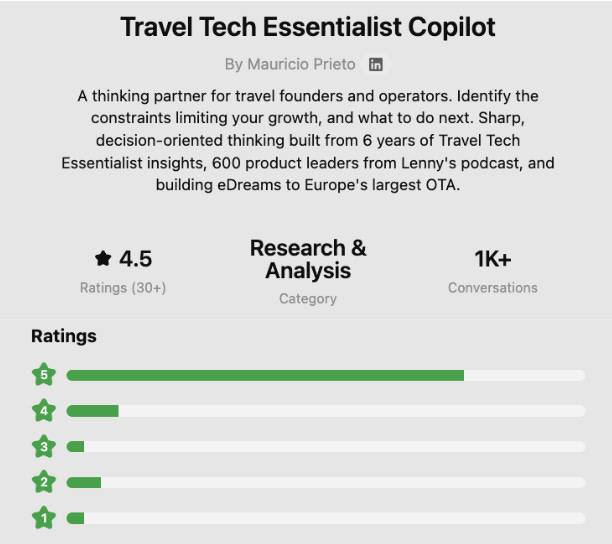
The Travel Tech Essentialist Copilot has now had over 1,000 conversations and holds a 4.5 rating. Try it with one problem you’re wrestling with and let me know where it gets things right or wrong.
If you’ve found value in Travel Tech Essentialist, the best way to say so is to share it with someone who’d appreciate it:
If you’re not yet subscribed, join us here:
Thanks for trusting me with your inbox.
Mauricio Prieto
Hadn't heard of Fora before, Travel Assistants who have AI in their toolset is one of my pet wishes for travel bookings. Seems mostly focused on luxury now, but as this becomes available for everyone, I think it will be a thing. Trust builds and it's great to know there's someone at the other end of the line who can help when things (inevitably) go wrong.