
Technology is supposed to kill middlemen, but travel keeps replacing one with another. A smaller plane can skip the hub. An AI agent can skip the OTA. But someone in the middle still has to aggregate the supply, take the payment and fix things when they go wrong. Some of the stories in this edition look at what happens when the middle gets squeezed.
Special thanks to Travel Trends Summit for sponsoring this edition of the newsletter:

Our Travel Trends Virtual Summit V3 is back Oct. 28-29, 2026, and this year we’re going Beyond AI. Join speakers from Deloitte, Microsoft, Fora, Mindtrip, Thayer Ventures, Amex GBT, Phocuswright and more for two days of keynotes, data briefings, live demos and candid conversations on tech, distribution, marketing and leadership. Tickets normally cost $149. Registration is now free. Register today!
What the car did that the plane hasn’t
Packy McCormick wrote a long piece on Airbound, a Bangalore startup he invested in. Airbound builds very light delivery drones that carry up to 5 kg.
Today your package sits in a warehouse until there are enough others to fill a truck, because a full truck is the cheapest way to move goods. Airbound wants a small drone to move each kilo almost as cheaply as that full truck, so your package can leave right away.
Planes have the same problem. A jet costs a lot to run, so you need enough passengers to make the route pay off. If you fly from New Orleans to Rome, you connect in Atlanta, New York or Houston. No airline can fill a plane between New Orleans and Rome every day, so the hub collects passengers from dozens of cities until there are enough. Package tours, charters and airport shuttles follow the same logic. You pay less per seat, but you leave when the group leaves.
The car broke that rule. One family could go where they wanted, when they wanted, at a price they could afford. The plane never has.
This gives you a simple question to ask about any new aircraft, route or travel product. Does it reduce how many people you need before a trip pays off? Each time that number drops, the route map changes.
Tenerife, twice a week
Air Canada just showed what happens when a plane needs fewer passengers to pay off. On October 25, it starts flying Toronto to Tenerife. Montréal follows six days later. They’re the first nonstop flights between Canada and the Canary Islands (Simple Flying).
The plane changes the economics of routes like these. The Airbus A321XLR is a single-aisle jet with 182 seats that flies about 8,700 km. That gives Air Canada widebody range without having to fill a widebody.
Tenerife isn’t alone. Air Canada already flies the XLR to Toulouse, Nantes and Lyon. Toronto to Oslo and Shannon, and Montréal to Basel, start next June. None of these cities would fill a Dreamliner from Canada several times a week.
A smaller long-range plane lets an airline start a route small and grow it if people show up. Montréal–Tenerife starts once a week and is already filed for three from April. If people don’t show up, the downside is smaller too. United tried Newark to Tenerife with a Boeing 757 and dropped it in 2025.
Expect more routes like this. Smaller markets, a few flights a week, nonstop where travelers used to connect through a bigger hub.
The travel agent in your texts
Instinct is a personal AI assistant you text, email or call. There’s no app. Its founder just gave his first long interview to Patrick O'Shaughnessy on Invest Like the Best. The company is a year old and still invite-only. He says the user base is growing about 10% a day with no marketing; enough to double roughly every week.
Three weeks after joining, 40% of users have given it their credit card. The founder says users who share a card or password retain at about 80%. The travel industry keeps asking whether people will trust an AI to book for them. These users already do. They spend close to $1 billion a year through Instinct, and half of it goes to travel.
In his favorite example, you send a voice note saying you need to be in New York tonight. The assistant books your usual airline and seat, the hotel you always pick, and the Ubers. You never open a website.
He offers a simple test for any company. How much of your revenue comes from people spending time in your app, seeing ads and upsells? How much comes from delivering the service? When an assistant books for you, nobody sees the ads. He puts travel agencies on the exposed side.
Agents also bring a cost. He describes one checking restaurant availability every five seconds, in every city. Travel suppliers already pay for searches that never become bookings. Keep an eye on look-to-book ratios and the cost of serving agent traffic that rarely converts.
He wants Instinct to stay free for users. Merchants would pay a cut of each booking. He expects travel to lead, because hotels already pay middlemen generous commissions.
An assistant paid by hotels will feel the same pull every OTA feels. When two hotels fit, the one paying more is hard to ignore. He promises Instinct will only act in the user's interest. If it can keep that promise while merchants pay the bill, OTAs have a new kind of competitor.
Three weeks of Muse
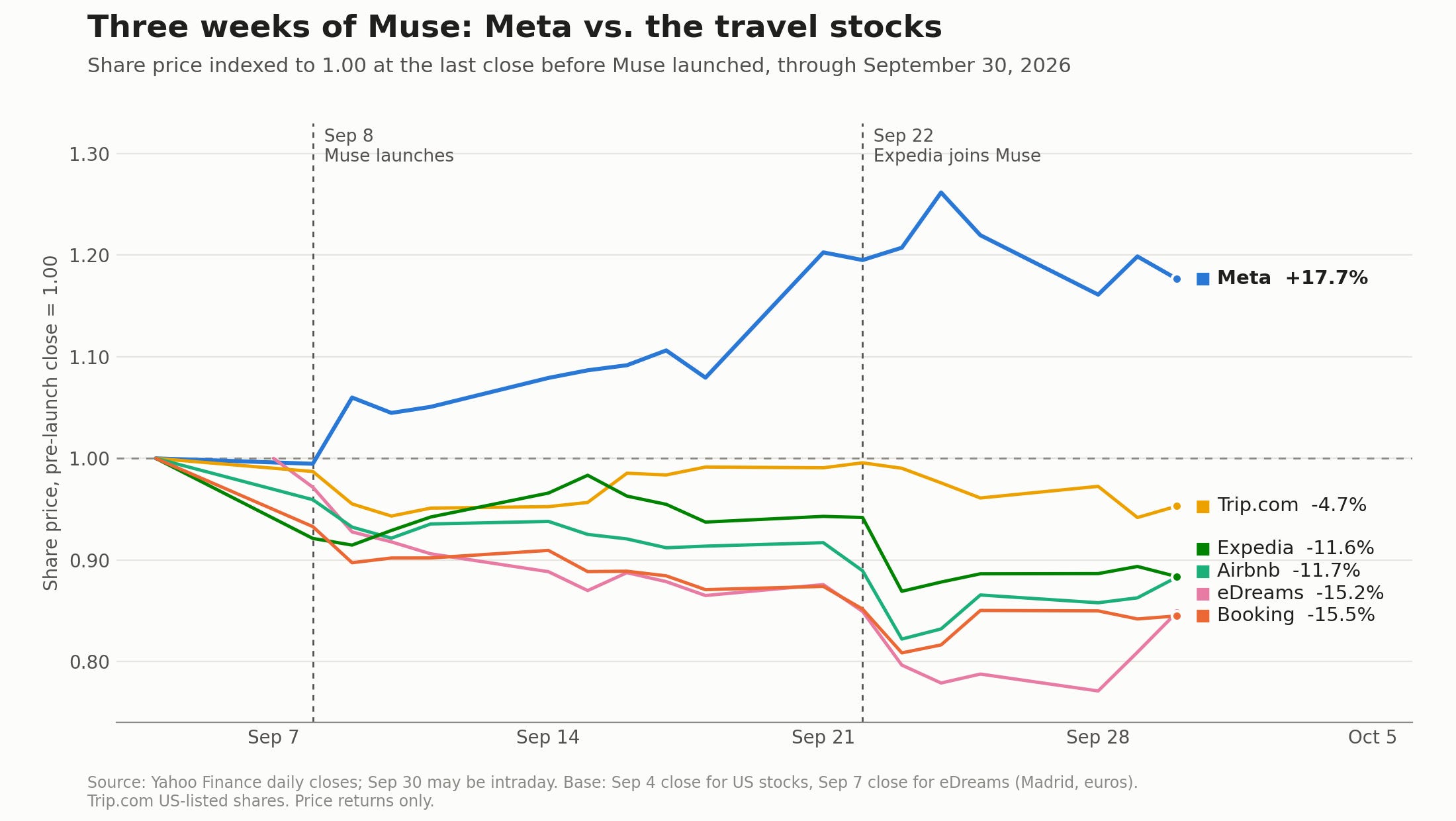
Meta launched its AI agent, Muse, on September 8. By the end of the month, Meta was up 18%. Every travel stock on the chart was down.
Booking and eDreams fell the most, about 15% each. The worst day came on September 23, right after Expedia announced it would sell hotels inside Muse. Investors read the deal as Expedia handing its front door to Meta. All the OTAs fell with it. Trip.com fell the least, 5%. Its customers are mostly in Asia, where Muse isn’t available.
A new landlord
Investors are already pricing in trouble for OTAs. But Thomas Reiner, an analyst at Altimeter, thinks the market is pricing the wrong thing. He uses a $1,000 hotel booking to show why. Today, Booking keeps $145 in commission, spends $45 on ads (mostly Google), and ends with $53 in EBITDA. Reiner runs three scenarios.
Agents send travelers to Booking for free, as they do today. The ad spend disappears and EBITDA rises to $98.
Meta charges a referral fee similar to what Booking pays Google. EBITDA barely moves, to $48. Booking just pays a new landlord.
Agents send travelers straight to the hotel’s own website. Booking only supplies the list of hotels, prices and availability, and keeps about $8 in EBITDA.
The market is pricing the third case, but reality today is the first, drifting toward the second.
The numbers back him up for now. AI sends well under 1% of Booking’s room nights. Three in four US travelers who plan a trip with AI still finish the booking somewhere else. And Reiner found that when you ask Muse or Instinct for a hotel, they mostly land on Booking or Expedia.
The reason is the unglamorous part of the business. An agent can connect to Marriott once. It can’t sign contracts with millions of small hotels in 200 countries, collect their payments, absorb the fraud and answer the phone when something goes wrong.
The OTA moat was never the search box. It was everything that happens after you click “book.”
Muse prefers direct
Analysts are modeling what AI agents mean for OTAs, but it’s better to ask an agent directly. Muse, Meta’s new agent, told me how it books travel.
For flights, it uses Duffel, a wholesale intermediary travelers never see. I asked whether it could book on eDreams or other flight-focused OTAs. It said yes, but warned that changes and issues would go through the OTA’s customer service, “which is usually slower than dealing with the airline directly.” For complex trips, it would rather book direct.
So I asked whether the same applied to Duffel. "Honestly, yes, and in one way it's worse with Duffel… eDreams at least has a support desk you can call, however slow. With Duffel there's no consumer-facing support line… For anything I can do natively, cancellation quotes, cancelling, checking status, I'm the support. But for changes I can't do, like new dates or a name correction, you're dealing with the airline directly, and some airlines push back on touching third-party-issued tickets."
Hotels are harder. Muse admitted it has no database of independent hotels. It searches the web, builds a shortlist, then opens each hotel’s site one by one. It can’t scan every boutique hotel in Sicily for a given week. It called OTAs “genuinely useful for discovery.” Then it said it would still book direct.
And interestingly, the agent has opinions about brands, which it shares with users before they reach your site. Those opinions changed the moment I pushed back.
Every OTA now has to win the agent's recommendation. And if those recommendations are this malleable, it may also need to teach customers what to tell their agents.
AI makes building cheap. Customers are still expensive.
HBR published “AI Is Changing the Rules of Entrepreneurship“ (paywalled, sorry). The authors claim the lean startup era is over. A solo founder with AI agents can now build products, websites and ads in parallel.
Then Steve Blank published a four-part series on what happened in his Stanford class this spring. Every team arrived on Day 1 with a finished, AI-built product. Then the learning stopped. Teams asked AI instead of customers. Interviews were full of compliments because people reacted to a product instead of describing a problem. Teams fell in love with their first build and pivoted late or never.
I saw it firsthand as a mentor in the Stanford Launchpad class, and in my own classes at Tulane and IESE. The hardest part was getting students to put the product away and listen.
Blank’s conclusion is sharper than HBR’s. AI has collapsed the cost of building an MVP. It hasn’t collapsed the cost of discovering whether anyone wants it. A product on Day 1 no longer proves skill, insight, or demand. Everything else still holds. You still need to know who has the problem and why they would pick you over dozens of fast followers, or over building it themselves.
So he retired the MVP. Teams test one small piece of the product at a time. AI can simulate interviews, but only real conversations count as evidence. And teams finish by landing a design partner (a customer who commits staff time, data, or workflow access).
In travel we see this every week. Anyone can launch an AI trip planner. Very few get a traveler to book once (or twice).
Build faster. Then close the laptop and go find a customer who commits and pays.
Fares up and profits down
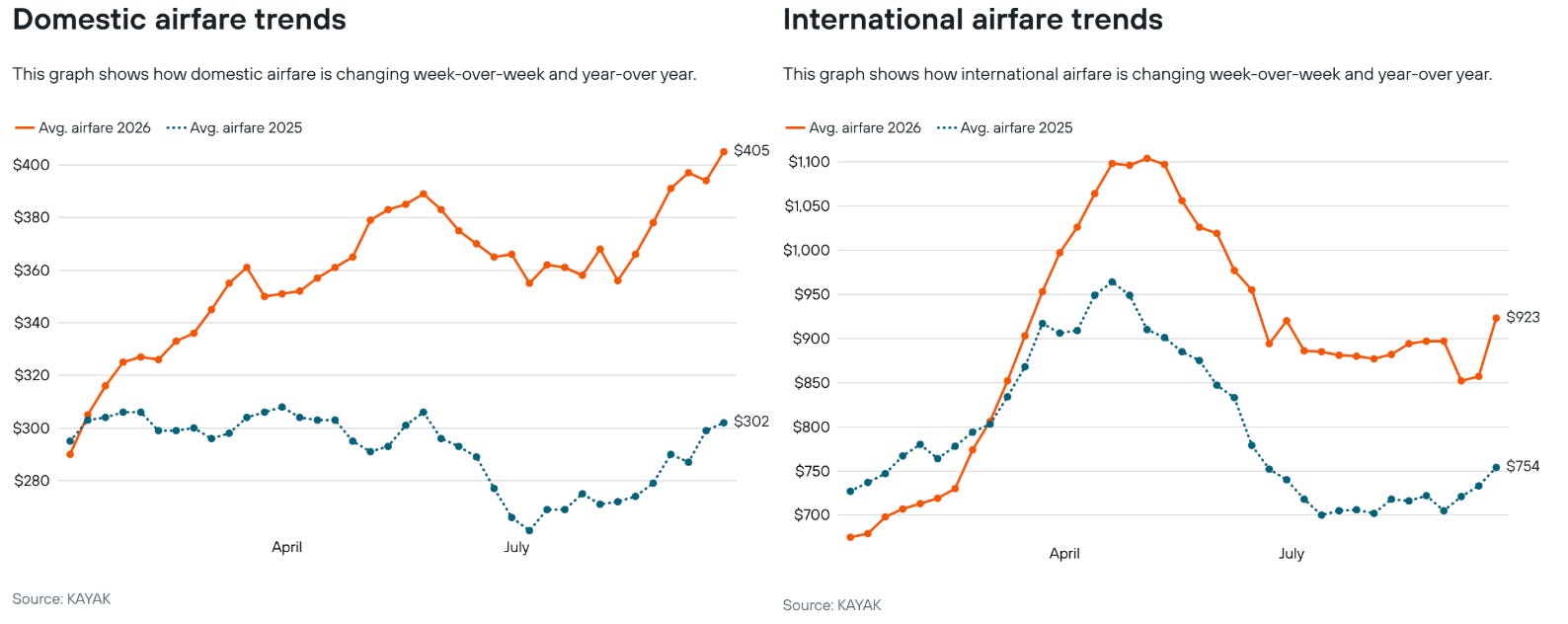
Airfares from the US are much higher than a year ago, according to KAYAK’s new airfare dashboard. The average domestic round trip now costs $405, against $302, up 34%. International flights from the US are up 22%, to $923 from $754. Both started the year at or below 2025 levels and have climbed since February. The dashboard also tracks fares week by week for 25 US and 25 international destinations. Barcelona, for example, is up 23%.
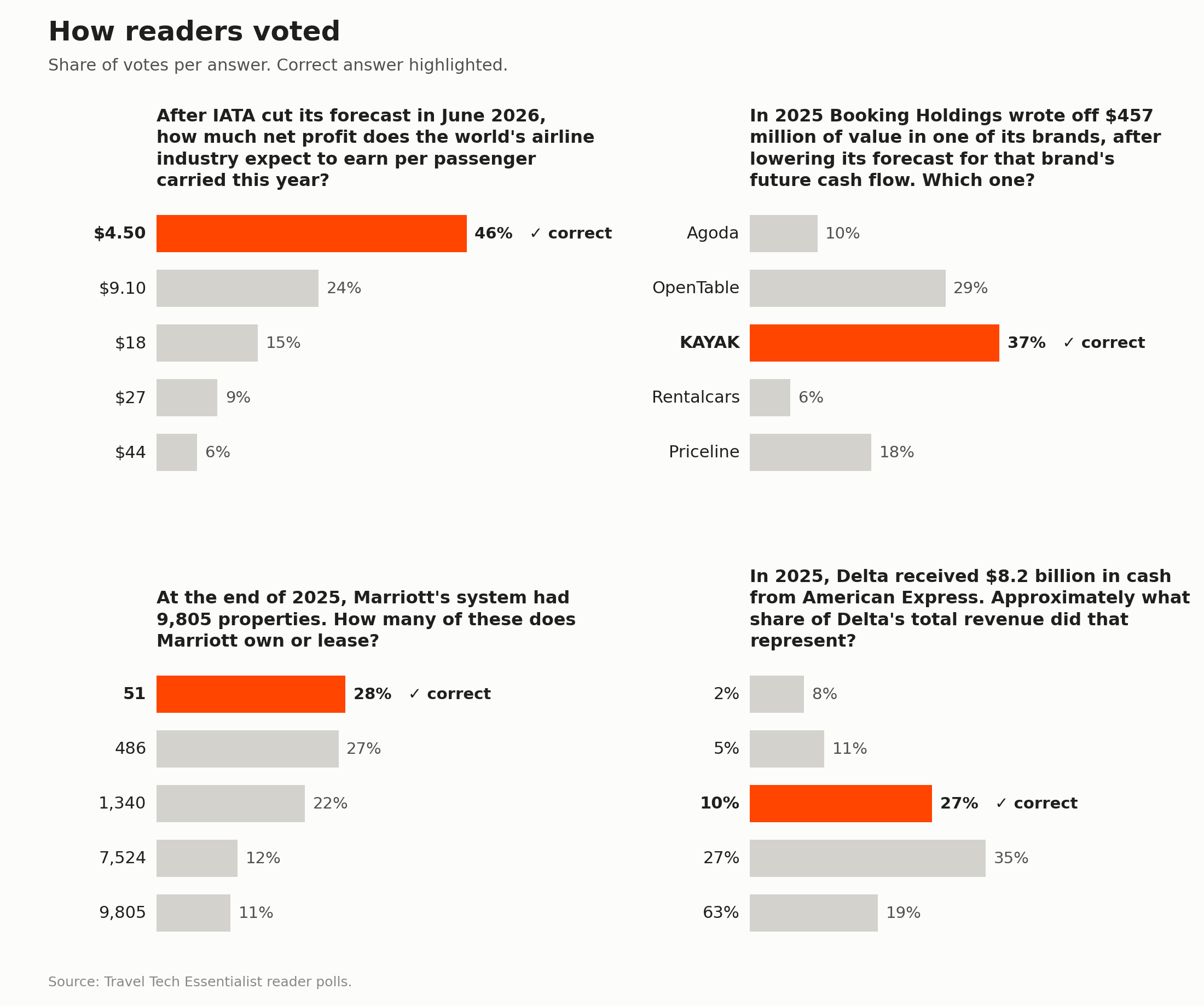
Higher US fares don’t necessarily mean bigger airline profits. As the poll below shows, IATA expects airlines worldwide to earn just $4.50 per passenger this year, half what they made in 2025. Jet fuel is up 70%, and fares can only pass on part of it.
How we did
In the last edition, more than 400 of you voted on four questions. In three of the four questions, the most popular answer was the right one, even though a majority of voters chose a wrong answer. The crowd missed one. More than half thought payments from Amex account for at least a quarter of Delta’s revenue. The real share is around 10%.
If you’ve found value in Travel Tech Essentialist, the best way to say so is to share it with someone who’d appreciate it:
If you’re not yet subscribed, join us here:
Thanks for trusting me with your inbox.
Mauricio Prieto
PS. More from Travel Tech Essentialist
Raising a round? If you’re a startup raising from pre-seed to Series D, I can help, for free. Travel Investor Network is a private platform where I recommend innovative travel startups to investors. To apply, complete this form.
Looking for your next role? Explore all 1357 open roles on the Travel Tech Essentialist Job Board, or subscribe to the Travel Tech Jobs newsletter for monthly updates.
the middle survives because someone has to own the mess, which is the whole case for curation over automation in wellness travel.
An AI agent may cut out the booking intermediary, but it won’t make the customer care less about who fixes a ruined trip. The middleman survives wherever someone has to own the failure. That applies well beyond travel.