
Interpretation runs through much of this issue. How we read a metric, a market, a consumer, or a framework determines what we build, how we compete, and what we believe to be true.
Special thanks to Propellic for sponsoring this edition of the newsletter:

NavLog is the bi-weekly, research-focused newsletter that turns real travel data into strategy you can actually use. Are you in the middle of budget planning? This is worth a read. It’s less noise, more signal, and zero generic takes → Join 2,000+ travel marketers
Not all Primes are created equal
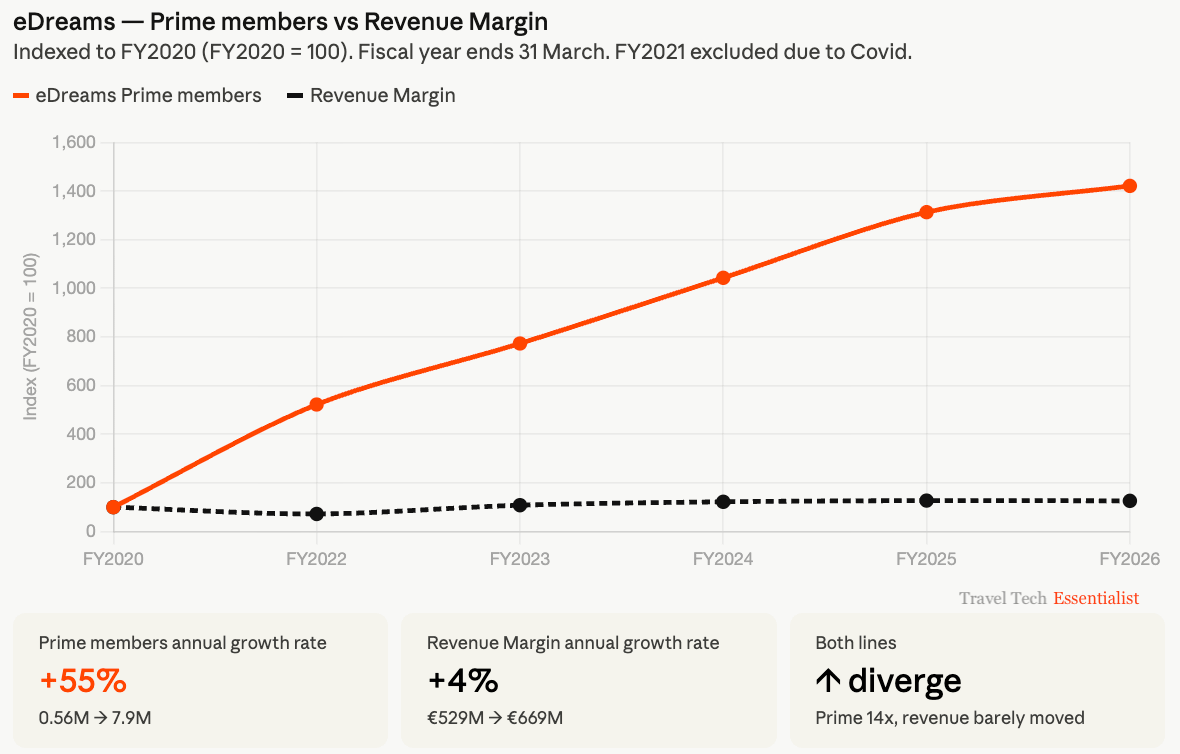
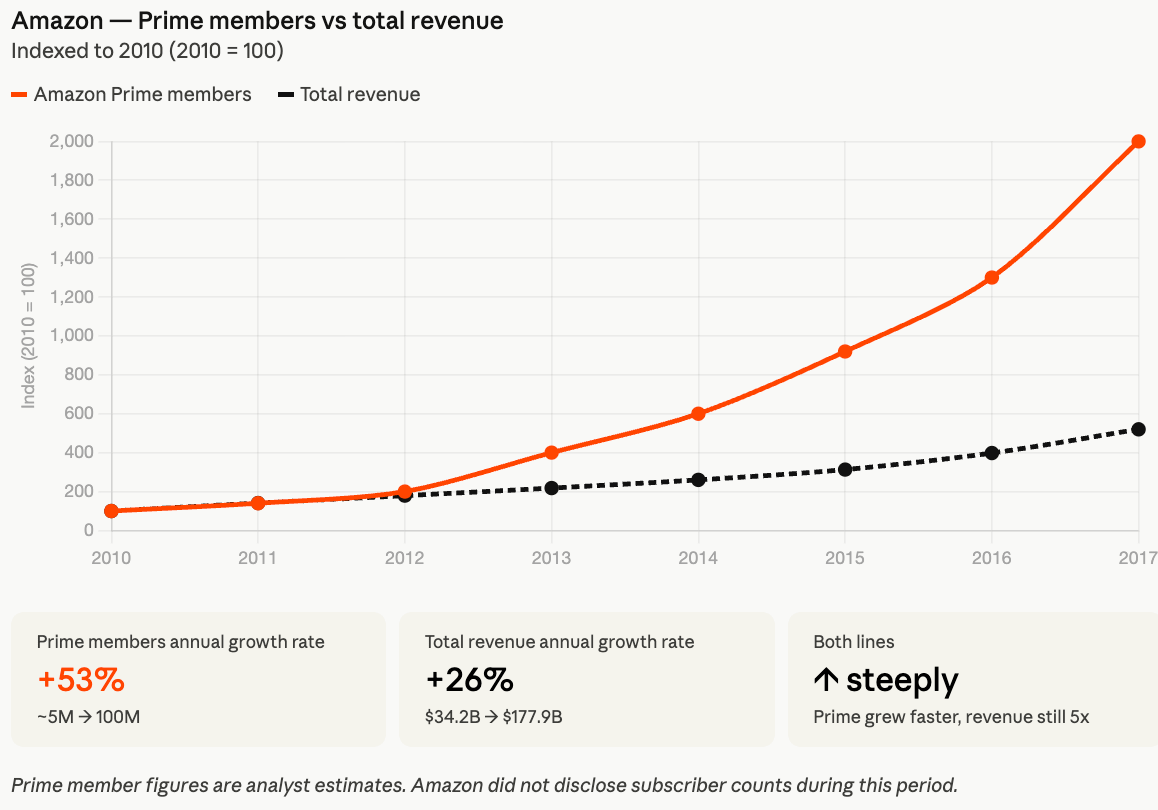
Both Amazon and eDreams can proudly show a Prime chart that shoots up and to the right. In both cases, Prime membership growth is impressive. The difference shows up when you plot total revenue on the same graph.
For eDreams, Prime members grew roughly 14x, from about half a million to nearly eight million. Revenue Margin, eDreams' preferred revenue metric, increased only modestly over the same period.
Amazon's early Prime years tell a different story. As Prime members scaled from the single-digit millions to around 100 million, total company revenue also moved sharply higher.
Prime membership should be celebrated, but it should also move the core business forward. eDreams has built an impressive subscriber base. But 9 years into it, the revenue needle tells a different story.
World Cup fan arbitrage
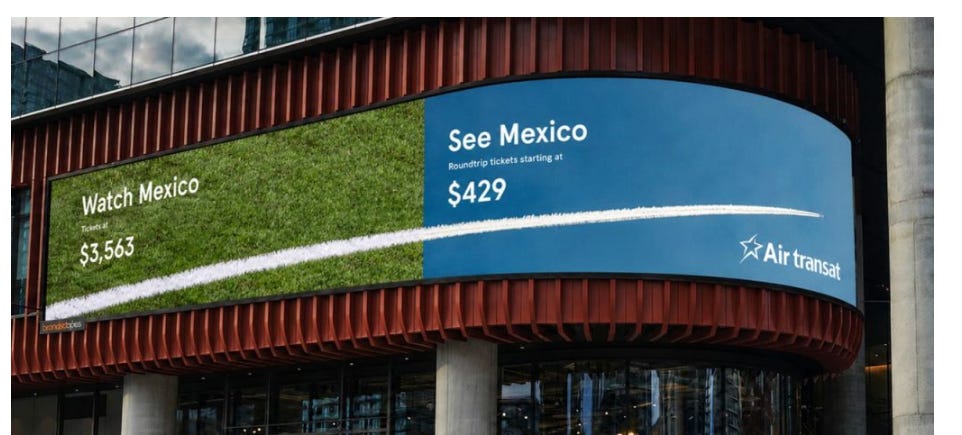
Canadian airline Air Transat is not a sponsor of the World Cup, but they just needed a billboard, two numbers, and a pain point. For the price of 90 minutes in a stadium, you could spend a week in the country you’re rooting for. And of course, some fans will see this, spend $429 on a flight to Mexico, and then drop $3,563 on a World Cup ticket anyway.
The Diderot Effect
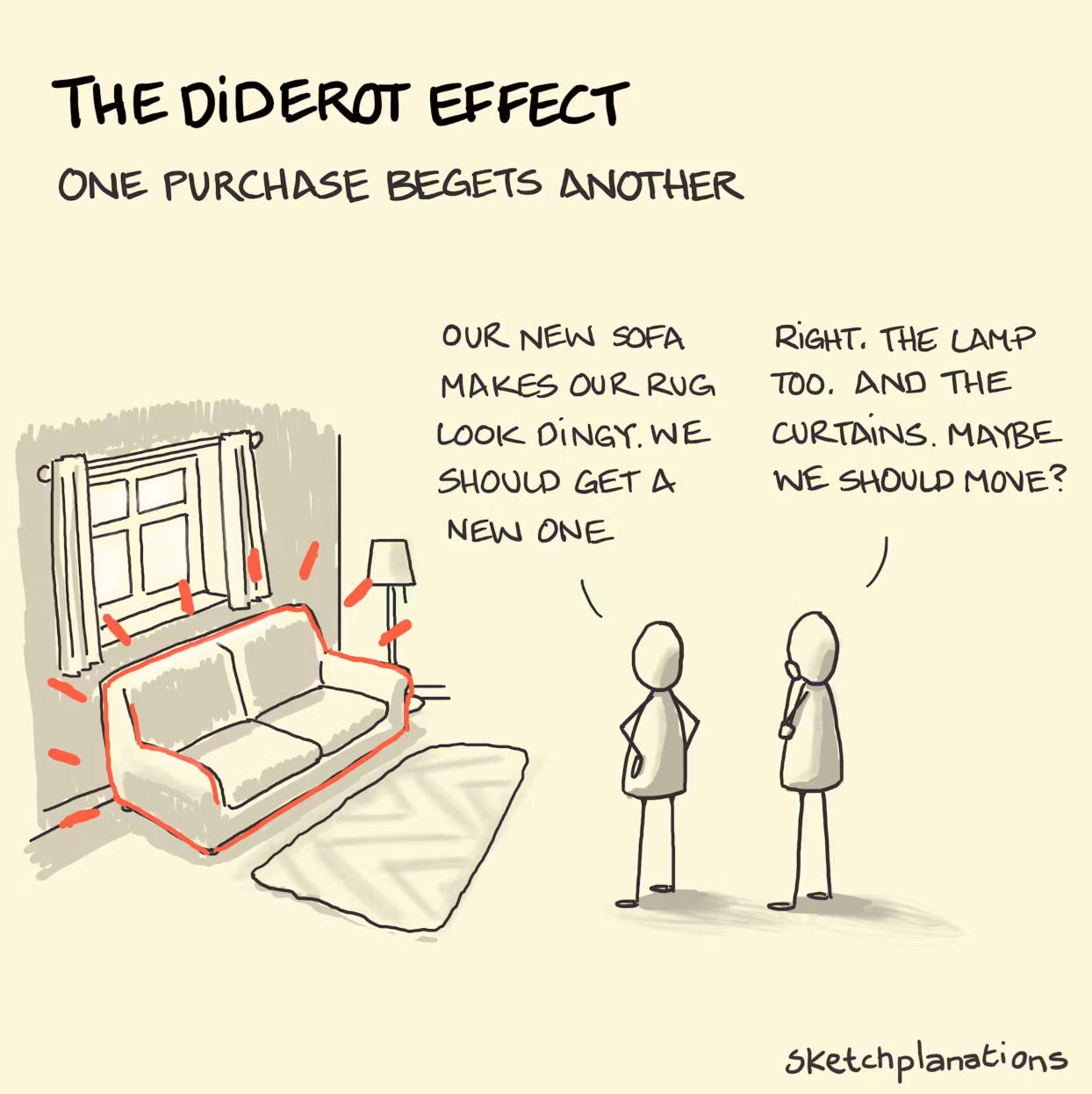
One purchase leads to another. Denis Diderot received a new dressing gown in 1769 and ended up replacing every possession in his home to match it, emptying his savings in the process.
Travel runs on this. Book a flight and suddenly your luggage looks inadequate. Book a hotel and suddenly the nicer room is only $40 more. Book a tour and you need the gear. The entire travel upsell industry is built on the fact that one purchase makes the next one feel necessary.
AI ignores most hotels
When a traveler asks ChatGPT where to stay in Barcelona, most hotels in the city will never appear. Lighthouse ran 4,545 prompts across nine destinations and five traveler personas and found that AI recommendations are highly concentrated; in Tokyo, only 10% of hotels were ever mentioned. In Paris, 13%. One property in Paris captured 3% of all mentions across a market of roughly 2,000 hotels.
Independent hotels do poorly. In Indianapolis, they captured 6.5% of mentions despite representing a much larger share of the supply. AI recommendations also skew luxury. Even with generic prompts and no budget signal, four- and five-star properties dominated. Three-star hotels were nearly absent.
Two findings stand out. First, 82% of AI sources come from OTAs and editorial sites like Forbes, Lonely Planet, and Condé Nast. Getting featured in a “best of” list is now a clear distribution strategy. Second, when AI recommends a property and the traveler clicks through, most clicks go directly to the hotel website, bypassing OTAs entirely. Read + Lighthouse
Proven Better New
Mark Pincus built a framework at Zynga called Proven Better New. Isolate your one genuine innovation and copy everything else that already works, at the pixel level, for your platform and audience. When Sid Meier (one of the most influential game designers in history) launched a social Civilization game on Facebook, Zynga’s PMs called it dead on arrival within an hour, and they ended up being right. He hadn’t copied their onboarding, which was already proven to work.
The problem is that founders become founders precisely because they want to innovate. Copying feels like cheating. Pincus calls it a moral arbitrage: the very instinct that makes you an entrepreneur is the one that will make you over-innovate and lose users before they ever reach your actual idea.
This runs counter to a common instinct where founders are often told to focus inward and worry less about competitors. The logic being that most startups die from suicide, not murder. Proven Better New complicates that. You need to know the competitive landscape deeply to know exactly what single element you will be betting on.
The other reframe is who you are building for. If you define your ambition in the eyes of your peers, you will over-innovate. If you define it in the eyes of your consumer, the nurse in Indiana playing Farmville, you will copy what she already loves, make it one inch better, and add one thing she didn’t know she wanted. Burning your resume, as Pincus puts it, means defining ambition in the eyes of your consumer rather than your peers.
The travel agent you never had
Mark Pincus, founder of Zynga and one of the most prolific consumer product builders in Silicon Valley history, was on Lenny’s Podcast recently and named the agentic travel agent as his number one example of latent consumer demand that AI can finally unlock. The reason we never had a great always-on travel agent, he argued, was that the economics didn’t make it possible. The commission model couldn’t support round-the-clock, personalized service for every traveler, and consumers weren’t willing to pay enough for it. The internet solved the price problem but not the service problem.
What he describes is something that knows your travel context, is available 24/7, and is ready to act when things go wrong mid-trip, such as rebooking flights, managing logistics when they fail in real time. That last part is where the value is, and where the current travel apps fall short.
He also raises the question of whether OpenAI or Anthropic will build this themselves. He says that an agentic travel agent is exactly the kind of consumer use case that gives people a clear reason to choose one LLM over another. Right now most users can't tell the difference between Claude and GPT. Consumer use cases like travel could be how they fix that.
Expedia’s paid AI advantage
While Booking, Airbnb, and Hilton are absent from ChatGPT Ads, Expedia is running unopposed in lodging. Flavio Rodrigues (Digital Sardine) spent three weeks inside the platform and found no other major competitor visible across dozens of queries tested. He also found that Expedia isn’t doing anything new. They took their existing Dynamic Search Ads infrastructure, destination × property type × amenity, and applied it to a new channel.
The entry point math explains part of the gap. Floor CPC is $3. At a 2% conversion rate, that’s roughly $150 per booking. Most OTAs can’t make those numbers work. Expedia, with bundle attach economics, can. The rest of the gap is operational lag, channel skepticism, and in Airbnb’s case, a deliberate choice to avoid performance marketing.
Flavio’s post offers a detailed breakdown of how the ChatGPT platform works, including targeting mechanics, bidding floors, who sees ads, and what travel brands need to know before testing. Read +
Maybe AI isn’t the only one hallucinating
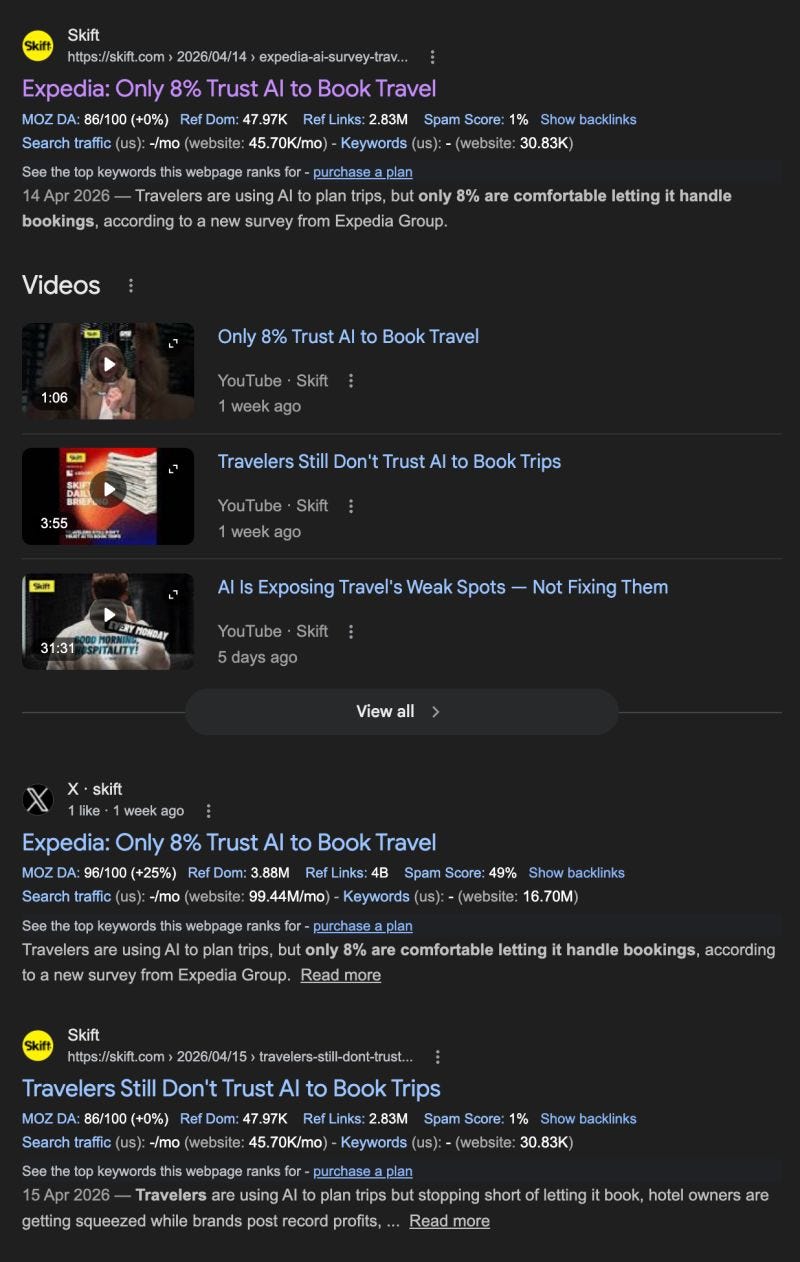
Lennart Dobravsky wrote a LinkedIn post that dug into Expedia’s AI Trust Gap report, which found that 66% of travelers don’t trust AI to book travel on their behalf. Skift, which calls itself “the trusted intelligence source for the global travel industry,” picked up Expedia’s report and ran with the headline “Expedia: Only 8% Trust AI to Book Travel.” But where did the 8% come from? As Lennart mentions, if 66% don’t trust AI to book on their behalf, it’s fair to assume that the remaining 34% either do trust it or are at least open to the idea. Lennart went back to the report and found that one statistic said that 8% of travelers currently rely on AI platforms for trip planning. But using AI for trip planning and trusting AI to book travel are very different things. Yet the headline became “industry truth” within 48 hours.
This was back in April. Two months later, I asked Claude what % of travelers trust AI for booking travel. Claude confidently cited 8%, pointing to the Expedia report. When I mentioned that Expedia referred to usage, not trust, Claude figured it out on its own: “You’re right. That’s a usage stat, not a trust stat. The 8% figure also appears in a Skift headline — ‘Only 8% Trust AI to Book Travel’ — which frames it as a trust stat. That headline is a distortion of the original data, and I repeated it uncritically.”
Lennart’s takeaway is right: always read the chart, then read the question behind the chart. I’d also add to keep an eye on the incentives of whoever is telling the story. “Only 8% Trust AI to Book Travel” drives more clicks than “8% Rely on AI for Trip Planning”. Two months later, the headline and article remain unchanged, and the interpretation has now spread far enough that AI systems are repeating it as fact.
🧭 Travel Tech Essentialist Copilot
I’ve been using it to pressure-test early-stage ideas and think through go-to-market questions. I’ve gotten sharp feedback and angles I hadn’t considered at all. — Emma Burton, Head of Operations & People, Oliver’s Travels
The Travel Tech Essentialist Copilot has now had over 1,000 conversations and holds a 4.5 rating. Try it and let me know what you think.

Travel Tech Essentialist Job Board
→ Explore all 1622 open roles on the Travel Tech Essentialist Job Board now.
Fora | Engineering Manager, Platform | New York City | $210k - $235k + Equity
Navan | Creative Director | New York City |$143k - $318k + Equity
AmTrav | Senior Product Manager - Post-Booking | Barcelona
Airbnb | Growth Marketing Lead, Metasearch & Paid Social | Paris | €96k - €120k
📩 For monthly updates on the latest roles, subscribe to the Travel Tech Jobs newsletter
Raising a round?
If you are a startup looking to raise a round (from pre-seed to Series D), I can help (for free). Travel Investor Network is a private platform where I recommend innovative travel startups to investors and innovators. If you’re interested, please start by completing this form.
If you’ve found value in Travel Tech Essentialist, the best way to say so is to share it with someone who’d appreciate it:
If you’re not yet subscribed, join us here:
Thanks for trusting me with your inbox.
Mauricio Prieto
I think the travel agent model where everything is agentic will take a long time to work. A good example is Alexa. Which is seemingly getting dumber and dumber. I can't even ask it for world cup times anymore. Cancel and rebooking travel can't be 89% right. As I've written many times before and seems to have become my pet AI idea is that we can now have thousands of Travel Assistants working on a gig-economy basis. Who act as quasi-agents, and can manage hundreds of clients a year at a fraction of the cost. But they're a text message or a call away. And we have more reassurance that they will get things right.
Here's what I wrote some time ago: https://martinsoler.substack.com/i/165767013/ai-isnt-the-end-of-travel-agents-its-their-industrial-revolution
The concentration of AI recommendations makes the source question more interesting than visibility alone. If most cited material comes from OTAs and editorial lists, an independent hotel may gain a direct click while still being defined by someone else’s representation. What would it take for the hotel to become the clearest source about itself, rather than simply another eligible result?